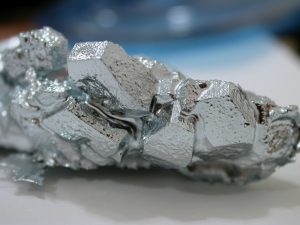
Most scrap sellers know the usual suspects: copper, aluminium, stainless steel. But hafnium? It barely comes up in conversation. That’s a problem, because hafnium scrap quietly ranks among the most valuable materials sitting in industrial waste streams today, and the overwhelming majority of it never gets recovered.
If you work in aerospace, nuclear, semiconductor manufacturing, or any field that deals with high-performance alloys and cutting equipment, there’s a good chance hafnium is already passing through your hands.
Here’s what you need to know about it.
What Hafnium Scrap Recovery Actually Means

Hafnium is a dense, silvery metal with an extraordinarily high melting point (hafnium has a melting point of over 2233°C) and an unusual ability to absorb neutrons without flinching.
Nobody mines hafnium directly. Instead, zirconium processing extracts it as a co-product, which permanently tethers its supply to how much zirconium the world happens to need.
That structural limitation has real consequences for price.
For every 50 tonnes of zirconium produced, roughly 1 tonne of hafnium comes out the other side. This, as Strategic Metals Invest notes, is “scarcity by design.”
No matter how much demand climbs, the supply side simply cannot respond quickly.
This is exactly why the secondary market, meaning recovered and recycled hafnium scrap, has become so strategically important to the industries that depend on it.
A Price Story Worth Paying Attention To
Hafnium’s price has surged dramatically in recent years, a trend that Strategic Metals Invest attributes to surging demand colliding with a supply base that simply cannot flex.
What was once a relatively obscure minor metal has become a closely watched commodity. This is particularly true as nuclear energy, aerospace, and semiconductor manufacturing all increasingly rely on hafnium-dependent technologies at the same time.
Where Hafnium Is Used and Where Hafnium Scrap Comes From

Nuclear Energy: The Largest Demand Driver
Nuclear energy is the single largest consumer of hafnium worldwide, and the reason comes down to physics. When a nuclear reactor needs to slow or stop the fission chain reaction, control rods are inserted into the reactor core.
The material used for those rods needs to efficiently absorb neutrons and withstand a punishing radiation environment without degrading.
SFA Oxford notes that hafnium’s exceptional neutron absorption and corrosion resistance make it the material of choice for reactor control rods. In this case, it outperforms most alternatives in both safety and longevity.
The scrap opportunity here is meaningful and growing.
As nuclear energy draws renewed global investment from decarbonisation targets and energy security concerns, the number of reactors being built, refuelled, and decommissioned is steadily rising.
Spent control rod materials and related reactor components represent a concentrated source of recoverable hafnium. They are typically handled through specialised channels, but worth understanding as part of the broader supply picture.
Aerospace and Jet Engine Superalloys

Aerospace pushes hafnium’s physical properties to their absolute limits and produces some of the most accessible industrial scrap in the process.
Jet engine turbine blades operate in conditions that would destroy most materials: temperatures exceeding the melting point of many common metals, combined with enormous mechanical stress and corrosive combustion gases.
To withstand those conditions, turbine blades are made from superalloys, precisely engineered combinations of nickel, cobalt, and other elements that retain their strength at extreme temperatures.
Hafnium is a key ingredient in these formulations because it improves both high-temperature strength and oxidation resistance.
Quest Metals points out that with each new generation of jet engines, demand for hafnium-containing alloys increases, which means the aerospace machining stream is both a current source of scrap and an expanding one.
Turnings, trimmings, off-cuts, and grindings from turbine component manufacturing all contain hafnium.
These materials are worth segregating carefully rather than allowing them to disappear into a general mixed-metal pile, where their value gets averaged down to near nothing.
Semiconductors and Advanced Microchips
Semiconductors represent a newer but rapidly expanding application that has added significant pressure on hafnium demand.
As chipmakers push transistor density toward physical limits, the insulating layers between components need to perform at ever-thinner dimensions, and traditional silicon dioxide simply can’t keep up.
Hafnium oxide (HfO₂) is now used as a high-k dielectric in advanced microchips, improving efficiency and heat tolerance in next-generation processors by replacing silicon dioxide in gate insulator layers.
This application requires hafnium of exceptional purity.
The fabrication process generates scrap in the form of sputtering targets, residues, and manufacturing waste that carries real recoverable value.
Unlike aerospace or nuclear scrap, semiconductor fabrication waste tends to arrive in smaller, more concentrated forms, but the purity and consistency of the material often make it more straightforward to assess and price accurately.
Plasma Cutting Equipment: The Most Common Source of Hafnium Scrap

For most industrial sellers, plasma cutting tips are the most practical and immediate source of hafnium scrap.
Manufacturers use hafnium as the electrode material in plasma cutting tips because it emits electrons efficiently under the intense heat of a plasma arc. This property stabilises the arc and extends tip life compared to other electrode materials.
Regular use wears these tips down, and any active cutting operation needs to replace them frequently.
Used tips accumulate quickly, and because they’re small and look like ordinary consumables, workers often toss them into general waste rather than setting them aside for proper recovery.
That’s a direct loss.
If your operation uses plasma-cutting equipment regularly, setting up a separate collection container for spent tips is one of the simplest steps you can take to start capturing value that’s currently going to waste.
Specialty Manufacturing and Other Applications
Hafnium also shows up in high-temperature ceramics, precision optics coatings, refractory equipment, and advanced coatings designed for extreme environments.
In each of these settings, scrap can appear as:
- Sheets
- Plates
- Coils
- Solid forms
- Powder residues
Assess these materials individually rather than as a bundle with general scrap, since their hafnium content can vary widely.
The pricing difference between informed and uninformed selling is substantial.
Why the Recycling Rate Is So Low, and What That Means for Sellers
Here’s a number worth sitting with: the current global end-of-life recycling rate for hafnium is approximately 1%.
Of all the hafnium that cycles through industrial use worldwide, only a tiny fraction ever makes it back into the supply chain through recovery and recycling. The rest gets discarded, melted down with mixed scrap, or simply lost.
For sellers, this means the material coming out of your shop floor or decommissioned equipment is genuinely rare on the secondary market, and buyers will pay accordingly.
Why Identification Is the Real Barrier
The low recycling rate isn’t entirely a matter of oversight.
Quest Metals explains that hafnium is frequently alloyed with other metals such as nickel or zirconium. In turn, identification and separation are genuinely difficult without the right knowledge and equipment.
Separating hafnium from zirconium in particular is technically demanding because the two elements are chemically almost identical, so similar, in fact, that hafnium wasn’t identified as a distinct element until 1923.
That complexity is exactly why so much of it slips through the cracks in general scrap recycling operations.
But for anyone who knows what they’re looking at and takes the time to segregate hafnium-bearing materials before they go into the mixed pile, the payoff is substantial.
What Hafnium Scrap Looks Like in Practice
Plasma cutting tips and electrodes are the most common and accessible source. Small components replaced regularly in cutting operations accumulate quickly when collected rather than discarded.
Aerospace machining scrap, including turnings, trimmings, and grindings from superalloy component work, is another major source.
The Critical and Strategic Metals Hub notes that manufacturing scrap from fabrication and processing achieves the highest recovery rates. This is thanks to the composition being known, and the collection can be controlled.
Sheets, plates, coils, and solid forms of hafnium or hafnium alloys also circulate through industrial channels, particularly in precision manufacturing and research settings.
Segregate and assess any of these on their own terms rather than lumping them in with general metal scrap.
Hafnium: The Market Behind the Metal
According to Future Market Insights, the global hafnium carbide market was valued at USD 217.0 million in 2025. It’s projected to reach USD 490.6 million by 2035. This reflects a compound annual growth rate of 8.5% over the forecast period.
Expanding demand in aerospace thermal shielding, nuclear reactors, and high-temperature electronics is driving that growth.
That kind of growth trajectory doesn’t happen with a material that’s easy to replace or abundantly available.
SFA Oxford clearly identifies the structural constraints: separating hafnium from zirconium is technically complex and costly, processing capacity is geographically concentrated, and secondary recovery from superalloy scrap remains stubbornly low.
For sellers, this translates directly into pricing leverage.
When constrained supply meets expanding demand across multiple high-growth industries simultaneously, the material you’re holding carries real weight.
Getting an accurate assessment of what you have, rather than selling it blind into a mixed scrap stream, is worth the extra step.
Expand on Hafnium Scrap Recovery with Scrap Gators
Have you been sitting on plasma cutting tips, aerospace machining scrap, or other hafnium-bearing materials without knowing what they’re actually worth? Now is the time to find out.
Scrap Gators works with Florida-based industrial sellers to get fair value out of specialty metals that most general yards overlook.
We know the difference between what hafnium scrap looks like and what it’s worth, and we’re not in the business of paying commodity prices for materials that belong in a specialty market.
Bring your materials in, get an honest assessment, and walk away knowing you got what the metal was actually worth.
Give us a call or stop by; we’re here to make the process straightforward.